

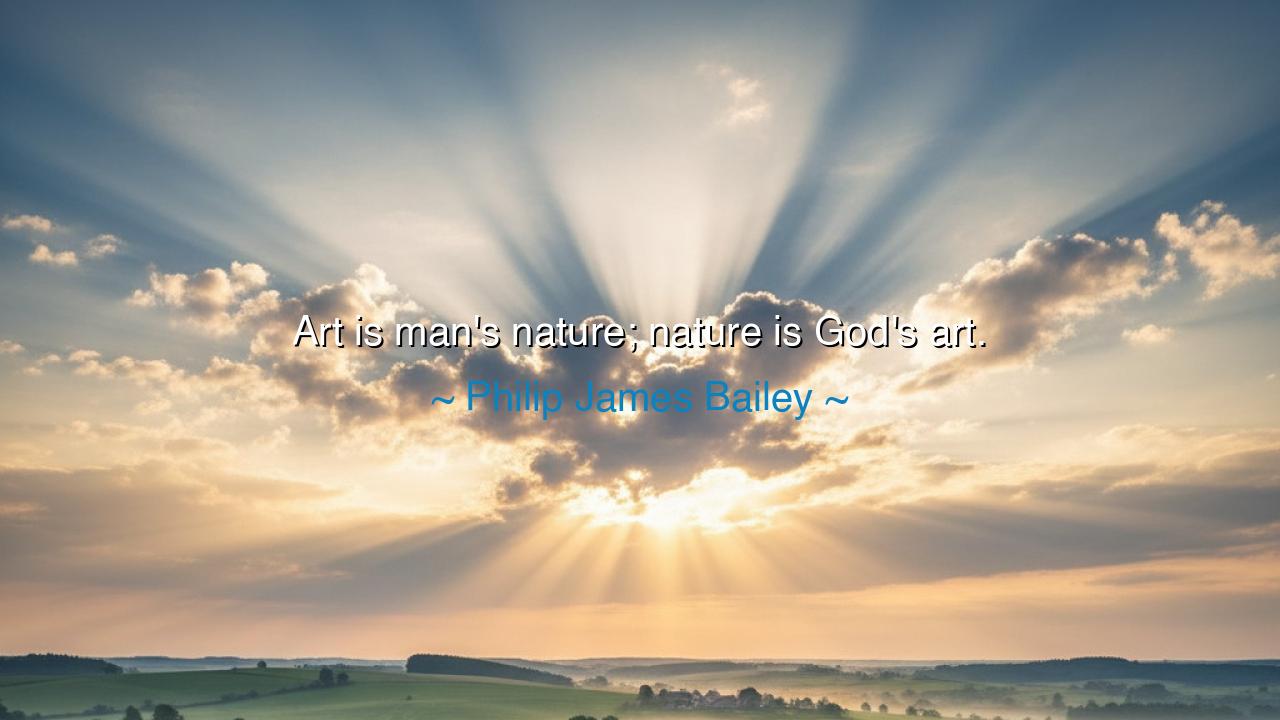
Art is man's nature; nature is God's art.









Host: The sun was setting behind a shattered horizon of rusted rooftops and twisted antennas. The city hummed like a tired machine. Smoke curled from street vendors’ grills, mixing with the faint smell of rain that hadn’t yet fallen. On a balcony high above the noise, Jack and Jeeny stood facing the dying light. Between them — a half-empty bottle of wine, two glasses, and the quiet ache of unspoken thoughts.
The air was warm, but a breeze carried a coolness that hinted at night. Golden dust shimmered over the concrete, as if the sun itself was signing its name on every wall.
Jeeny turned, her hair brushing across her shoulder, her eyes fixed on the sky.
Jeeny: “Art is man’s nature; nature is God’s art… Bailey’s words, but they sound like a confession, don’t they?”
Jack leaned against the railing, his grey eyes reflecting the orange glow.
Jack: “A confession? More like wishful thinking. Art is what we invent to make sense of chaos. Nature doesn’t need a painter or a poet — it just is.”
Host: A car horn echoed from below, breaking the stillness. The city was alive, yet the balcony felt like a different world — suspended, almost sacred.
Jeeny: “But that’s the point, Jack. Nature is so perfectly composed, so balanced — it breathes, it creates, it destroys. Isn’t that what art does too? Maybe God is the artist, and we are His medium.”
Jack: “Or maybe we just project our need for meaning onto randomness. You see a painting in a sunset; I see physics, atmospheric scattering, refraction. The universe doesn’t care about beauty — we do.”
Host: The wind shifted, lifting the curtain behind them. The room inside was dim, filled with half-finished sketches, brushes, and empty coffee cups. The signs of creation, and of exhaustion.
Jeeny smiled softly.
Jeeny: “You talk like a machine, Jack. But even machines can’t help producing patterns. Isn’t that proof that creation is inherent, even in the coldest logic?”
Jack: “Patterns aren’t art, Jeeny. They’re structure. Predictable, repetitive. A hurricane forms a spiral, not because it’s beautiful, but because physics demands it.”
Jeeny: “Yet we stand and watch it, awed, even when it destroys. That’s the human part — to see meaning in the indifferent.”
Host: The light faded further, the sky turning from amber to violet. A train whistled in the distance, long and lonely, as if mourning the end of day.
Jack: “Let me ask you this — if God is the artist, why does His art include so much suffering? Floods, diseases, wars. Is that beauty, too?”
Jeeny: “Maybe it’s truth. An artist doesn’t just paint the light — they paint the shadows. Suffering gives shape to joy, the same way darkness defines light.”
Jack: “Sounds poetic, but tell that to the families who lost everything in a war. You think they’re part of God’s masterpiece?”
Host: Jack’s voice cracked slightly, the huskiness tinged with anger, or perhaps pain. Jeeny noticed, but didn’t speak. She waited — her silence like a mirror.
Jeeny: “Maybe they are, Jack. The Pietà — remember? Michelangelo carved a mother holding her dead son, and the world called it sacred. Beauty born from grief.”
Jack: “That’s human art. A man trying to understand pain. But if God made the pain to begin with, then He’s no artist — He’s a tyrant with a palette of blood.”
Host: The breeze died, and for a moment, the city was silent. A flickering neon sign across the street glowed, pulsing like a heartbeat. In its light, their faces looked both young and ancient.
Jeeny: “You always see the wound, never the healing. Maybe God’s art isn’t about control, but about freedom — the freedom to feel, to choose, to create our own echo of His nature.”
Jack: “Freedom’s just a word we use to comfort ourselves when we realize we’re not in charge.”
Jeeny: “And yet you paint, Jack. You write. You build. If you truly believed that nothing mattered, you’d have stopped long ago.”
Host: Jack looked away, fingers tightening around the glass. The wine trembled, catching a shard of light. His jaw set, his eyes darkened.
Jack: “I create because silence is worse. Because if I don’t, I’ll vanish into the void. Maybe art is our way of screaming back at nothingness.”
Jeeny: “Exactly. That’s what Bailey meant. Art is our nature, our way of mirroring the divine — even if we doubt it. Nature is God’s canvas, and we’re just trying to paint our own corner of it.”
Host: The moon had risen, silvering the edges of the balcony. The streets below were glittering with reflections of light on wet pavement. A distant rain had finally fallen, somewhere unseen.
Jack: “So, you think humans are just miniature gods, imitating their creator?”
Jeeny: “No. I think we’re students. Some learn through logic, others through love. But we’re all trying to understand the same masterpiece.”
Jack: “Then what’s the lesson? That beauty justifies pain?”
Jeeny: “That existence itself is the art. The process, not the product. Creation, even flawed, is sacred.”
Host: A pause stretched between them — not of disagreement, but of recognition. The city’s murmur softened, and the sound of a violin rose faintly from a window below, like a whisper of the universe itself.
Jack sighed, looking at the sky, now deep and blue-black, studded with distant stars.
Jack: “Maybe you’re right, Jeeny. Maybe art is how we translate God’s silence. How we answer back.”
Jeeny: “And maybe God’s art is how He reminds us that silence can still be beautiful.”
Host: Jack smiled, a small, broken, but real smile. Jeeny reached for his hand, their fingers touching in the silver glow. The world around them hummed, alive with both chaos and order, sorrow and grace — the two halves of the same painting.
As the moonlight flooded the balcony, the city below breathed, and somewhere between the dust of man and the breath of God, the line between art and nature blurred, like paint in the rain.

AAdministratorAdministrator
Welcome, honored guests. Please leave a comment, we will respond soon