

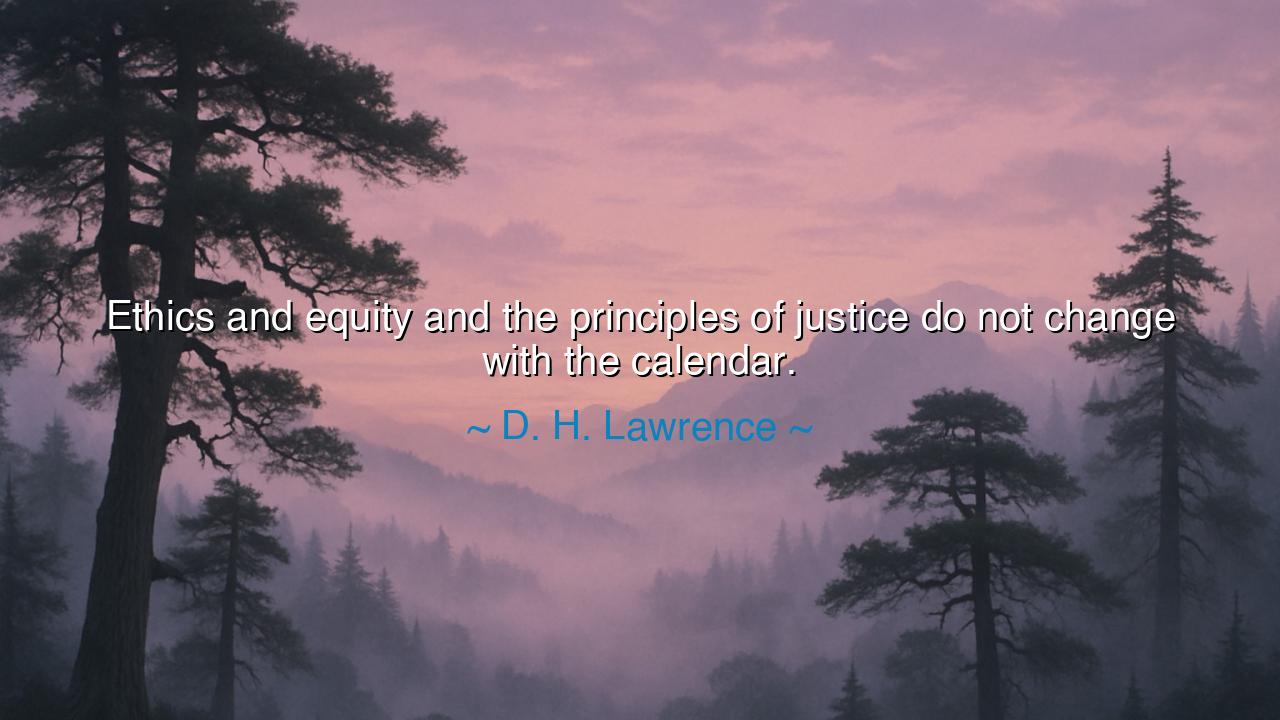
Ethics and equity and the principles of justice do not change










Host: The library was old enough to smell like thought itself —
a mix of aged paper, polished oak, and quiet dust.
Light poured through the tall stained-glass windows,
fractured into colors that lay across the long tables
like the faded flags of forgotten ideals.
It was late afternoon —
the hour when time feels tired but not yet defeated.
At a table near the far wall, Jack sat hunched over a stack of books —
philosophy, law, history — the great chroniclers of mankind’s attempts
to name what is right.
He looked restless, a storm behind calm eyes.
Across from him, Jeeny closed a leather-bound volume,
her fingers resting on the cover as if on a pulse.
Jeeny: (quietly) “D. H. Lawrence once said —
‘Ethics and equity and the principles of justice do not change with the calendar.’”
Jack: (leaning back) “Beautiful. But naive.”
Jeeny: “Why naive?”
Jack: “Because the calendar does change people.
Power shifts. Morality evolves. What was once called justice
might now be oppression in disguise.”
Jeeny: “Then you’re talking about perception, not principle.
Justice doesn’t change — our courage to uphold it does.”
Host: The light shifted, landing on the gold lettering of the book before her —
“On Liberty.”
The air felt charged, as if centuries of debate were listening in,
leaning close to the table where two modern souls
dared to continue the argument.
Jack: “But come on, Jeeny — look at history.
Every age has its version of righteousness.
Rome had its laws. So did the Inquisition.
So does every corrupt state hiding behind the word order.
Justice bends with whoever holds the pen.”
Jeeny: “No, Jack. The handwriting changes — not the message.
Even when people twist it, the truth remains the same underneath.
You can fake justice, but you can’t reinvent it.”
Jack: “So you’re saying ethics are eternal?”
Jeeny: “Yes — because they’re not inventions, they’re discoveries.
Like gravity or sunlight — they exist whether we acknowledge them or not.”
Host: A breeze wandered through the half-open window,
stirring the edges of loose papers,
as if the room itself sighed in agreement — or warning.
Jack: “And yet every government, every system, rewrites morality
to suit the moment. To justify the cruelty of the day.
They call it progress.”
Jeeny: “Progress isn’t new laws; it’s old truths remembered.
We don’t evolve past justice.
We only rediscover how far we’ve drifted from it.”
Jack: (half-smiling) “You talk like a prophet.”
Jeeny: “No. Like someone who’s seen how easily people forget what they already know.”
Host: The clock on the wall ticked steadily, its rhythm like a heartbeat.
Outside, the faint murmur of rain began —
soft, deliberate, cleansing.
Jack: “If ethics don’t change, why do we keep fighting over them?
Abortion, war, power, poverty — every generation thinks it’s the first
to argue right and wrong.”
Jeeny: “Because every generation forgets its predecessors’ pain.
We mistake novelty for wisdom.
But the questions are ancient.
Only the costumes change.”
Jack: (after a pause) “Then maybe the calendar isn’t the problem.
Maybe it’s us — the same flawed species,
just dressing our greed in modern vocabulary.”
Jeeny: “Exactly. We don’t need new morals, Jack.
We need the humility to apply the old ones.”
Host: The rain intensified,
casting ripples of silver light across the windowpanes.
Somewhere deep in the building, a librarian closed a drawer with a gentle thud —
a punctuation mark to their growing silence.
Jack: “You know what scares me most?
That we keep making ethics relative —
‘different times, different standards.’
That’s how people excuse cruelty.”
Jeeny: “Yes. That’s how it begins —
with people convincing themselves that kindness has an expiration date.”
Jack: “And yet kindness is the first casualty in every revolution.”
Jeeny: “Only when justice becomes a slogan instead of a practice.”
Host: Jack leaned forward, elbows on the table,
his voice lower now — raw, like a confession.
Jack: “You know, sometimes I think justice isn’t eternal.
It’s fragile. Like glass.
Shatter it once, and all we do after is walk barefoot through the pieces.”
Jeeny: “But every act of decency, every quiet refusal to follow cruelty —
that’s how we rebuild it. Piece by piece.”
Jack: “You make it sound so simple.”
Jeeny: “It’s not simple. It’s constant.
Justice isn’t a destination. It’s maintenance.”
Host: The lights dimmed slightly as the rainclouds thickened outside.
The sound of the storm became a soft percussion,
the library now a sanctuary —
its silence alive with the pulse of principle.
Jeeny: “Lawrence was right.
Ethics don’t follow fashion.
The truth isn’t seasonal.
The moral compass doesn’t get reset every January.”
Jack: “Then why do we keep losing direction?”
Jeeny: “Because we keep looking for shortcuts through compromise.
Justice is hard work. And hard work is rarely popular.”
Host: She stood then, gathering her notes,
the sound of paper crisp against the deep hush of the room.
Jack watched her, his skepticism softened by something quieter —
respect, maybe. Or realization.
Jack: “So what do we do?”
Jeeny: (turning to him) “We hold the line.
Even when everyone else says the calendar’s changed.”
Jack: “And when the line starts to break?”
Jeeny: “Then we remember who drew it.”
Host: The rain softened again, fading into mist.
The light through the stained glass glowed a muted gold now,
as if the sun were quietly applauding behind the clouds.
Jeeny walked toward the door, pausing before leaving.
Jeeny: “Justice doesn’t age, Jack.
Only our attention to it does.”
Jack sat still, watching the dust dance in the last beam of light,
the echo of her words lingering like the scent of rain.
Host: And as the scene faded —
the sound of the rain, the clock, the turning of a page —
D. H. Lawrence’s truth rang clear,
ancient and immediate all at once:
That justice does not belong to eras,
nor ethics to epochs.
That while time may alter the tools,
it cannot rewrite the truth.
And that in every generation,
the world waits — desperately —
for someone to remember that
right and wrong are not fashion trends,
but foundations.
For though the calendar turns,
the conscience must stand still.

AAdministratorAdministrator
Welcome, honored guests. Please leave a comment, we will respond soon