

Hope is like the sun, which, as we journey toward it, casts the
Hope is like the sun, which, as we journey toward it, casts the shadow of our burden behind us.
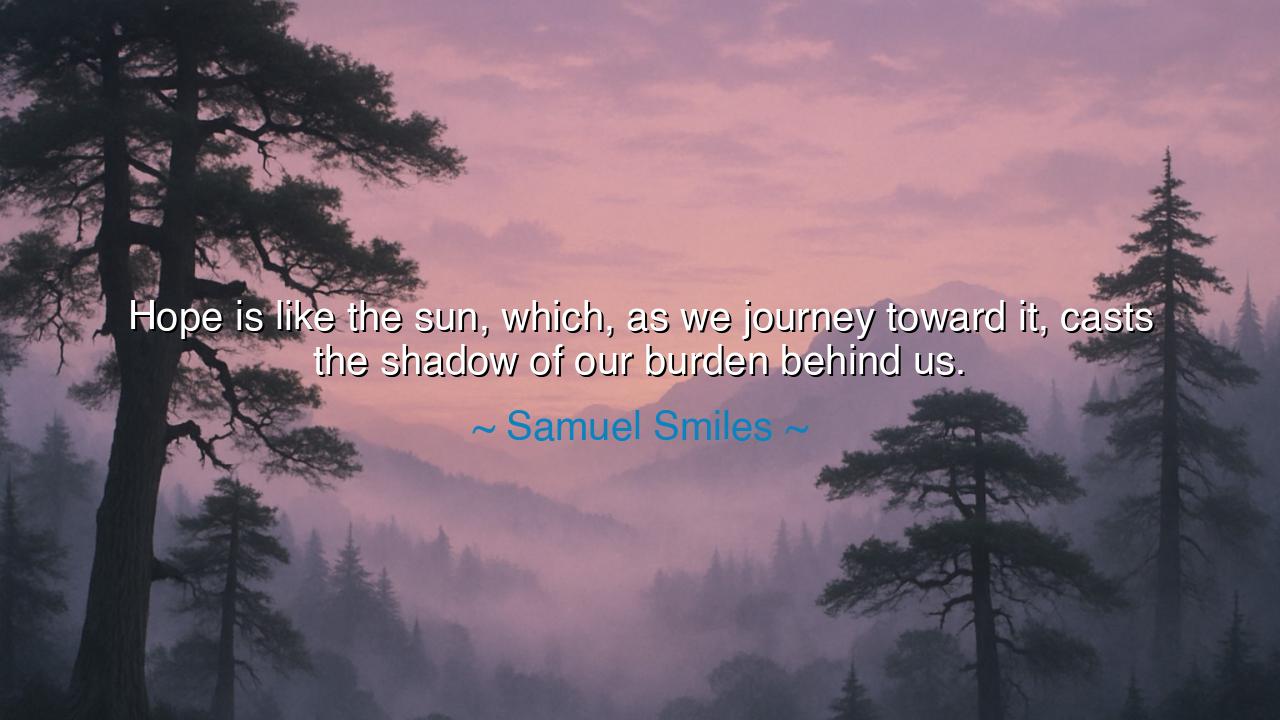










“Hope is like the sun, which, as we journey toward it, casts the shadow of our burden behind us.” So wrote Samuel Smiles, the Scottish philosopher and moralist whose pen illuminated the virtues of perseverance and self-help in an age of hardship. His words are a lantern for weary souls — a reminder that hope, like the sun, does not remove the darkness, but gives it its rightful place. For when we walk toward the light, our burdens — those shadows of sorrow, doubt, and fear — fall behind us, lengthening only when we turn our backs upon the dawn.
In this saying, Smiles reveals one of the great paradoxes of the human spirit: that hope does not erase suffering, but transforms its weight. The journey toward hope is not without pain or toil; it is a path often steep and uncertain. Yet, as long as the traveler fixes his gaze upon the sun, he moves forward with strength renewed. The shadow — his burden, his grief, his regret — still exists, but it no longer leads him. It trails behind, silent and powerless before the light that draws him onward. Thus, Smiles teaches that hope is not the denial of sorrow, but the victory over its tyranny.
To understand these words, we must know something of the man who spoke them. Samuel Smiles lived through an age of great industrial struggle — a time when men toiled in iron and soot, when poverty and despair were the common lot of laborers. Yet Smiles, through observation and compassion, came to believe that within every human heart burns a spark of self-reliance and faith, capable of lighting even the darkest workshop. His book Self-Help became a gospel of resilience, teaching that character, diligence, and hope could uplift not only the individual, but the whole of society. Thus his image of hope as the sun was born — not as a dreamer’s fantasy, but as a truth proven by life’s long labor.
Consider the tale of Ernest Shackleton, the polar explorer whose ship, the Endurance, was trapped and crushed in the Antarctic ice. For months, he and his crew faced hunger, cold, and the endless white silence of death. Yet Shackleton refused to surrender. He kept alive a flame of hope — in himself and in his men. Each morning, he urged them to face the light, not the dark, to labor, sing, and laugh in the face of despair. In the end, not a single man was lost. Hope, like the sun, guided them across the frozen sea, and their burden, though great, fell behind them as they pressed onward.
The ancients too knew this truth. The Greeks told of Prometheus, who, though chained to a rock for his defiance, looked ever eastward, awaiting the dawn. Hope was his strength against suffering, his inner sun that no darkness could quench. Likewise, in every age, the human soul finds its renewal not by fleeing hardship, but by orienting itself toward meaning — toward that radiant purpose which lights the path and drives the shadows away.
Smiles’ metaphor reminds us that where we place our gaze determines the weight of our suffering. If we face backward — if we dwell upon loss, failure, or injustice — then our burden walks before us, blotting out the sun. But when we lift our eyes toward the light — toward faith, love, or purpose — we find that our burden remains, but it no longer rules us. The journey does not become easy, but it becomes possible, and in that possibility lies the miracle of the human heart.
Therefore, the lesson is clear: walk toward the sun. Let your eyes rest not on the shadow, but on the light that beckons you forward. When despair whispers, take another step; when fear grips you, lift your head higher. The shadow will always follow you — but only as long as you move toward something greater. In your labor, your grief, your striving, make hope your compass and the sun your friend.
For in the end, as Samuel Smiles so gently teaches, hope is not the absence of burden, but the art of carrying it in light. The sun shines for all who choose to walk beneath it. And as you journey forward, your burdens — though real — will fade behind you, until one day you turn and see that all that once weighed you down has been transformed into a trail of shadows marking the path you have overcome.

AAdministratorAdministrator
Welcome, honored guests. Please leave a comment, we will respond soon