

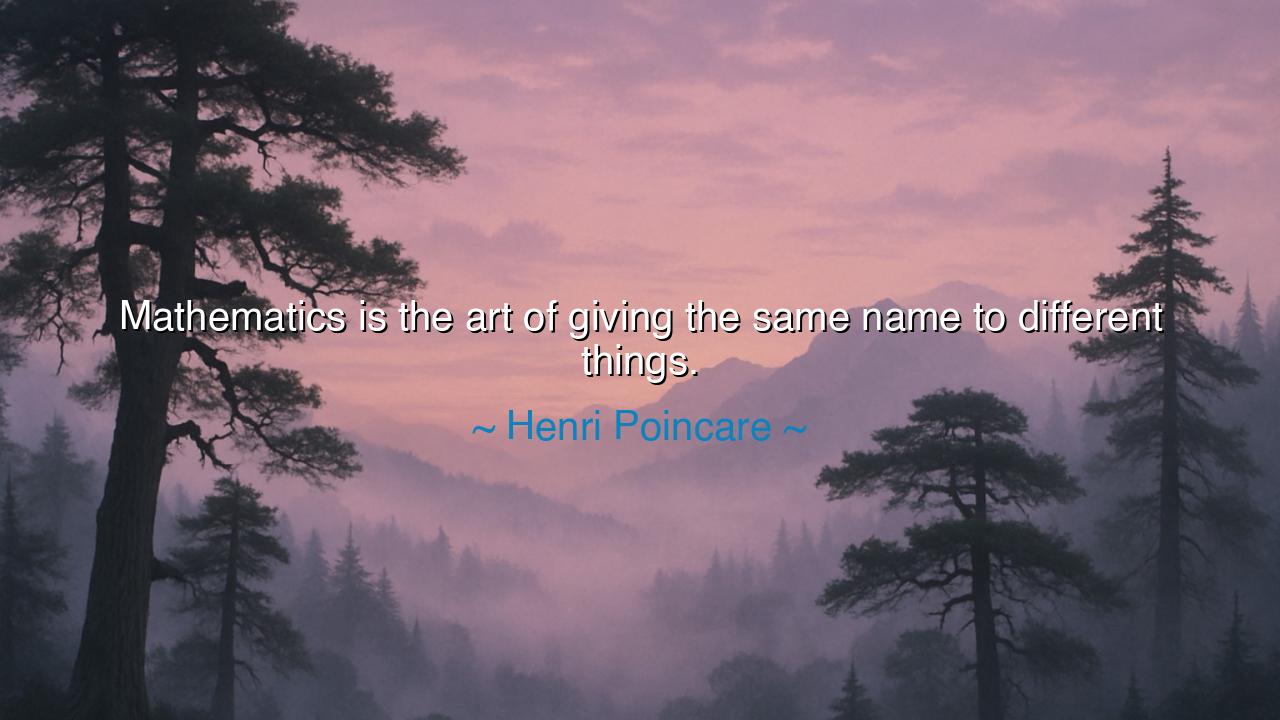
Mathematics is the art of giving the same name to different









Host: The rain fell in a quiet, deliberate rhythm — each drop tracing lines down the window like invisible equations dissolving into glass. The library was nearly empty at this hour. Shelves of books, shadows of words, and the hum of an old lamp painted the space in muted gold. Jack sat by the window, his sharp features dimly lit, a stack of papers before him covered in precise numbers and symbols. Across from him, Jeeny rested her chin on her hand, eyes deep and alive, staring at the rain as if it carried answers.
Outside, the world blurred into one soft, continuous motion. Inside, two minds prepared to divide and debate.
Jeeny: “Henri Poincaré once said, ‘Mathematics is the art of giving the same name to different things.’”
(she smiled faintly) “It’s beautiful, isn’t it? Like calling the heart and the universe by the same word — rhythm.”
Jack: (without looking up) “Beautiful, sure. But it’s not poetry. It’s precision. Poincaré wasn’t romanticizing — he meant abstraction. Mathematics simplifies. It unifies different phenomena under one law. It’s efficiency, not emotion.”
Jeeny: “And yet that efficiency is what makes it art, Jack. The moment you give different things the same name — you’re not just categorizing; you’re connecting. It’s how the human mind finds harmony.”
Host: The lamp light trembled slightly as the wind pressed against the window. Jack’s pen paused mid-stroke. For a moment, the air between them carried a quiet current — something unspoken, suspended, like a thought waiting to be solved.
Jack: “Harmony’s not the goal. Understanding is. You call gravity, magnetism, and attraction by the same formula because it works — not because it’s poetic. It’s just nature’s economy.”
Jeeny: “But don’t you see? That’s exactly what makes it poetic. The same pattern binding an apple to the Earth and planets to the Sun — that’s more than economy. That’s meaning. That’s unity disguised as science.”
Jack: “Meaning’s a human invention. The universe doesn’t care what we call it — it just is. Poincaré was describing mental efficiency, not cosmic empathy.”
Jeeny: “You always cut out the wonder, Jack. It’s like you’re afraid of it.”
Host: Her voice softened but her words landed like soft hammers. Jack looked up at her, his grey eyes catching the reflection of raindrops — small worlds of light trembling on the edge of his lashes.
Jack: “I’m not afraid of wonder. I just think calling everything by the same name doesn’t make it profound — it makes it blurry. Math gives clarity, Jeeny. It draws lines, not poetry.”
Jeeny: “But even lines can form art. Think of music — just organized frequency, mathematical relationships, and yet it moves us to tears. Isn’t that what Poincaré meant? The same name — different sensations.”
Jack: “You’re stretching the metaphor.”
Jeeny: “Am I? Or are you shrinking it?”
Host: A distant thunder rolled like a quiet drumbeat, steady and deep. The light flickered, turning their faces into chiaroscuro — half illuminated by reason, half veiled in emotion.
Jack: “You know what I think? I think people like to pretend there’s beauty in abstraction because it makes the coldness easier to swallow. Equations don’t care about you, or me, or our interpretations. They’re indifferent truths.”
Jeeny: “But maybe that’s where beauty begins — in the indifference itself. That something so cold, so precise, could reflect patterns of warmth, movement, even love. When a mathematician names two different things the same, they’re not erasing difference — they’re finding a bridge.”
Jack: “A bridge between illusions, maybe.”
Jeeny: “Or between realities that mirror one another. Isn’t that what all creation does — find sameness in difference? The painter sees light in shadow, the poet finds pain in joy. The mathematician does the same — only with numbers instead of words.”
Host: The rain grew heavier, a silver curtain over the city. The sound wrapped the room like static — chaotic, yet rhythmic. Jack set his pen down, finally surrendering to the pull of her logic, or perhaps her belief.
Jack: “Alright, let’s test your theory. Suppose we call the orbit of a planet and the arc of a thrown stone by the same name — parabolic motion. You see art in that?”
Jeeny: “Yes. Because in that sameness, we see ourselves. The small and the vast, the human and the cosmic — they share a curve. That’s not coincidence. That’s reflection.”
Jack: “Or it’s just gravity.”
Jeeny: “And gravity is just love without emotion.”
Jack: (laughs) “That’s absurd.”
Jeeny: “Is it? Both pull things together. Both keep them from floating away.”
Host: Jack’s laughter died quietly, replaced by a pause — the kind that signals more than doubt, something close to vulnerability. The rainlight trembled over the open pages of his notebook, forming tiny mirrored constellations.
Jack: “You always find ways to make logic emotional.”
Jeeny: “And you always find ways to make emotion mechanical.”
Jack: “That’s balance.”
Jeeny: “That’s distance.”
Host: Her words hit like a whisper that leaves an echo. Jack leaned back, eyes drifting toward the window — watching raindrops merge into one another, forming streams, then rivers. The patterns were clear. Even chaos obeyed form.
Jeeny: “You know, Einstein once said that pure mathematics is, in its way, the poetry of logical ideas. I think Poincaré was saying the same — that the act of naming isn’t cold classification, it’s intimacy. To give things the same name is to say: I see you as part of something larger.”
Jack: “But doesn’t that erase individuality? You can’t just name two different things alike and pretend they’re one.”
Jeeny: “No. You recognize difference through sameness. It’s like love again — you love two people differently, but the feeling that defines that love carries one name. The emotion remains, even if its expression changes.”
Jack: “So you’re saying love and math are the same?”
Jeeny: “I’m saying they rhyme.”
Host: The clock ticked faintly in the background — a quiet rhythm marking the passage of thought. The rain began to slow, softening into mist. Jack’s expression shifted; his cynicism began to blur at the edges, replaced by quiet curiosity.
Jack: “Maybe that’s what we do, too — you and I. We argue about different things, but somehow it’s always the same conversation.”
Jeeny: (smiling) “That’s because we’re part of the same equation, Jack — just different variables.”
Jack: “And if the equation balances?”
Jeeny: “Then maybe we’ve learned something about harmony.”
Host: Outside, the clouds began to break, revealing streaks of silver and faint hints of blue. The light filtered through the window, scattering across the table — over Jack’s notebook, Jeeny’s hand, the half-empty coffee cups, and the reflections of two minds converging in their difference.
Jack: “You know… maybe you’re right. Maybe math isn’t just numbers. Maybe it’s a way of naming our endless attempts to find connection — even between things that shouldn’t fit.”
Jeeny: “That’s all art ever is. Connection disguised as creation.”
Jack: “Then Poincaré was both a scientist and a poet.”
Jeeny: “As we all are, in our own ways.”
Host: The rain had stopped. The sky hung quiet and still, the pavement below glistening like a newly written equation. Jeeny reached for her cup, her fingers brushing against Jack’s hand — briefly, accidentally, inevitably.
A tiny moment — two separate things sharing the same name.
For an instant, they both smiled, realizing Poincaré’s truth was not confined to chalkboards or theorems — it lived in human connection, in shared silence, in the merging of difference into recognition.
And as the light poured in through the window, naming everything gold, the world seemed to whisper back its agreement:
That mathematics — like love, like life — is indeed the art of giving the same name to different things.

AAdministratorAdministrator
Welcome, honored guests. Please leave a comment, we will respond soon