

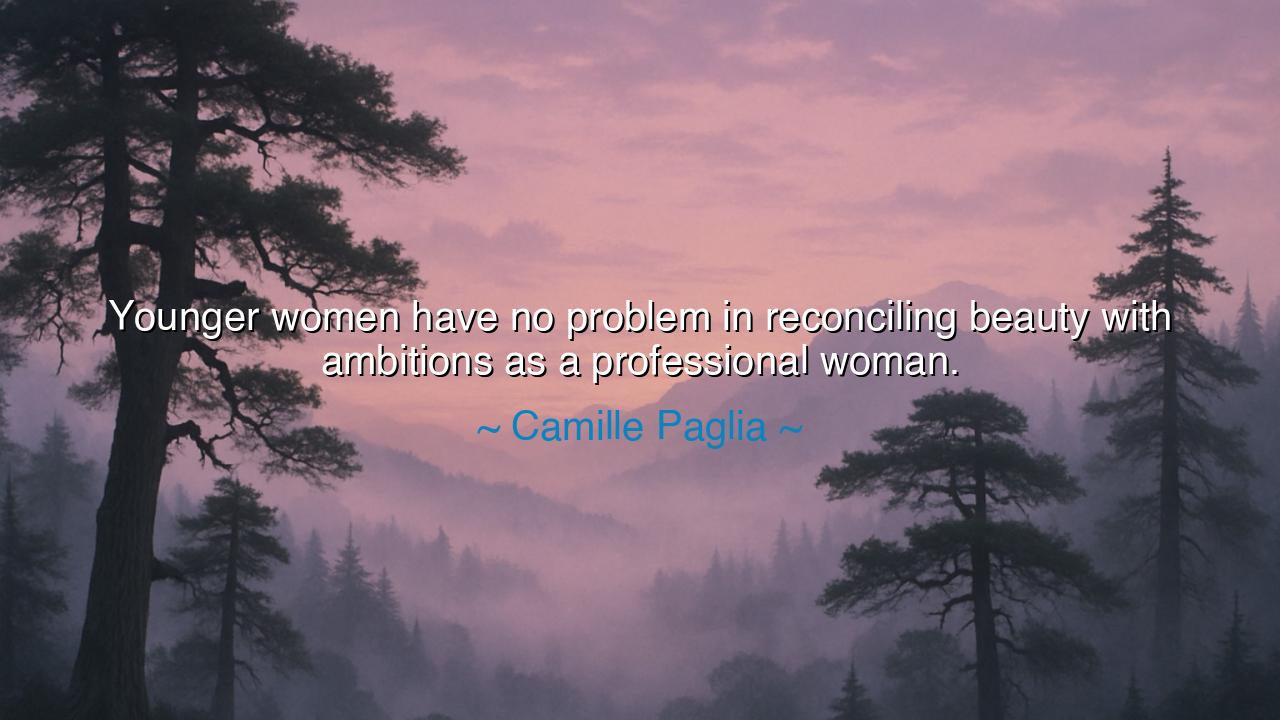
Younger women have no problem in reconciling beauty with
Younger women have no problem in reconciling beauty with ambitions as a professional woman.









Host: The city was a breathing organism, pulsing with light, smoke, and the low hum of ambition. It was late evening — that liminal hour when buildings glowed like lanterns and streets mirrored their reflection in rain-slick asphalt.
Inside a corner bar, tucked between a row of offices, Jack and Jeeny sat opposite each other at a high table by the window. The bar was half-empty, filled with the scent of citrus, bourbon, and the faint trace of perfume from passing strangers.
Jeeny’s hair caught the gold light from a nearby lamp, her brown eyes sharp and alive. Jack leaned back, sleeves rolled up, his grey eyes watching her with a mix of curiosity and challenge.
The quote lay printed on a torn page between them — Camille Paglia’s words, bold and unapologetic:
“Younger women have no problem in reconciling beauty with ambitions as a professional woman.”
Jeeny: “She’s right, you know. We finally stopped apologizing for wanting to be both.”
Jack: (raising an eyebrow) “Both? You mean beautiful and successful? Sounds nice on paper, Jeeny. But you think the world’s really caught up to that idea?”
Host: The bartender slid two glasses across the counter, the ice chiming softly, like fragile truths waiting to melt.
Jeeny: “Not entirely. But younger women don’t wait for permission anymore. They don’t hide their lipstick when they walk into boardrooms. They don’t lower their voices to sound more ‘serious.’ They’ve realized power isn’t about mimicking men — it’s about being whole.”
Jack: “Whole, sure. But the system still rewards one version of ‘professional.’ You can be ambitious, but not too assertive. Attractive, but not distracting. It’s a tightrope, Jeeny. Every step judged.”
Jeeny: “That’s the point. It’s not a tightrope anymore if you stop performing. Look at leaders now — women CEOs, politicians, creators. They’re not stripping themselves of beauty to earn respect. They’re redefining what respect looks like.”
Host: Outside, a neon sign flickered in the drizzle, painting their faces in shifting hues of red and blue, as if their argument itself was made of light and shadow.
Jack: “I don’t buy it. Society still weaponizes beauty. The same people who celebrate it also use it to discredit. A woman’s face is either her advantage or her downfall — never neutral.”
Jeeny: “That’s the old gaze, Jack. The one Paglia fought against. The younger generation sees beauty as expression, not a trap. Being beautiful doesn’t mean being compliant. It can mean being visible — on your own terms.”
Jack: (smirking) “You make it sound like beauty’s become political.”
Jeeny: “It always was. Cleopatra ruled with kohl-lined eyes. Frida Kahlo painted her pain and her power in color. Marilyn Monroe turned desire into commentary. The difference is — now we own the narrative. We say: ‘Yes, I’m ambitious. Yes, I wear red lipstick. And neither cancels the other.’”
Host: Her voice carried a quiet fury, but also a note of hope, the kind that doesn’t burn — it glows. Jack stared into his glass, watching the ice dissolve, his reflection rippling in the amber.
Jack: “But can everyone afford that confidence? Let’s be real — there’s privilege in being able to declare beauty as empowerment. What about the women who don’t fit the commercial idea of it? What about the ones who don’t want to play the visual game at all?”
Jeeny: (nodding) “That’s fair. But redefining beauty doesn’t mean narrowing it — it means expanding it. The girl with a buzz cut, the one with scars, the one who doesn’t care for makeup — they’re all part of it now. Ambition doesn’t have a face type. The younger women Paglia’s talking about aren’t buying into one standard — they’re shattering it.”
Host: The bar grew quieter. A group of office workers had left, leaving behind half-empty glasses and the faint echo of laughter. The rain outside thickened, the streetlights turning each drop into tiny sparks.
Jack: “You really think it’s that simple? That we’ve outgrown the paradox? The workplace still judges appearance — subtle or not. The same woman who gets praised for being ‘put together’ gets mocked for caring too much about looks. It’s hypocrisy dressed as progress.”
Jeeny: “It’s not simple, no. But progress never is. Every generation inherits contradictions — we just try to carry them differently. The difference now is that women know the double standard, and they refuse to be defined by it.”
Jack: “And you think men have no version of that pressure?”
Jeeny: “Of course they do. But let’s not pretend it’s the same. A man’s ‘roughness’ reads as experience. A woman’s reads as failure. A man’s wrinkles mean wisdom; a woman’s mean she’s expired.”
Host: Jack laughed, not mockingly, but like someone stung by recognition. He rubbed his chin, tracing the faint shadow of stubble — time written in skin.
Jack: “Touché. So what’s the solution, then? Just... own it? Smile at the glass ceiling and strut in heels across it?”
Jeeny: “Maybe. Or maybe stop calling it a glass ceiling and start calling it a mirror — one that reflects our fears more than our limits. When women stop seeing ambition and beauty as contradictions, the ceiling stops being invisible.”
Host: A beat of silence passed. The bartender dimmed the lights further. Outside, a taxi splashed through a puddle, scattering the reflection of a bright billboard — a woman’s face, bold, unapologetic, eyes meeting the world’s.
Jack: (softly) “You sound like you’ve lived this fight.”
Jeeny: “We all have. Every woman who’s ever walked into a room and been looked at before being listened to has lived it. But we’re learning. Beauty used to be a cage; now it’s armor.”
Jack: “Armor?”
Jeeny: “Yes. When it’s chosen — not imposed. When you wear it to express, not impress. That’s what Paglia meant, I think. Younger women aren’t fighting to reconcile anymore — they’ve realized there’s nothing to reconcile.”
Host: The rain outside had softened into mist, the kind that makes the city lights shimmer like secrets. Jack looked at Jeeny, her confidence quiet but radiant — not defiant, just certain.
Jack: “So, the modern woman can be both Venus and Athena.”
Jeeny: (smiling) “Exactly. Wisdom with red lips. Strength with softness. The contradiction was always a lie told by those afraid of complexity.”
Host: A pause, deep and still, hung between them. The music from the bar shifted — a soft jazz tune, steady as breath. Jack took a slow sip, his eyes thoughtful, less skeptical now.
Jack: “You make it sound inevitable — this evolution. Like it’s already here.”
Jeeny: “It is. You see it in every young woman who walks into work wearing what she loves, leading without apology. We grew up watching women who had to choose between beauty and ambition. Now we’ve learned that choice was never real — it was inherited.”
Host: The camera might have moved closer then — Jeeny’s face framed against the window, raindrops like tiny constellations reflecting the world outside. Jack’s reflection beside hers — the skeptic, now softened.
Jack: “So maybe Paglia was right — maybe the war’s not between beauty and ambition anymore. Maybe it’s between authenticity and expectation.”
Jeeny: “And authenticity’s finally winning.”
Host: The rain stopped. The city outside exhaled. Lights shimmered on wet pavement, and inside the bar, two silhouettes sat in quiet understanding — not as opponents, but as witnesses to the slow turning of time.
For a moment, the world seemed to balance — beauty and purpose, strength and grace — not as opposites, but as reflections in the same glass.
The camera lingered, capturing the stillness before fade-out — Jeeny’s soft smile, Jack’s nod, and the faint echo of Camille Paglia’s truth:
Younger women have no problem in reconciling beauty with ambition — because they’ve learned that both are born of the same fire.

AAdministratorAdministrator
Welcome, honored guests. Please leave a comment, we will respond soon